Skip to main contentSkip to main content
Back to Blog
Peptide Testing

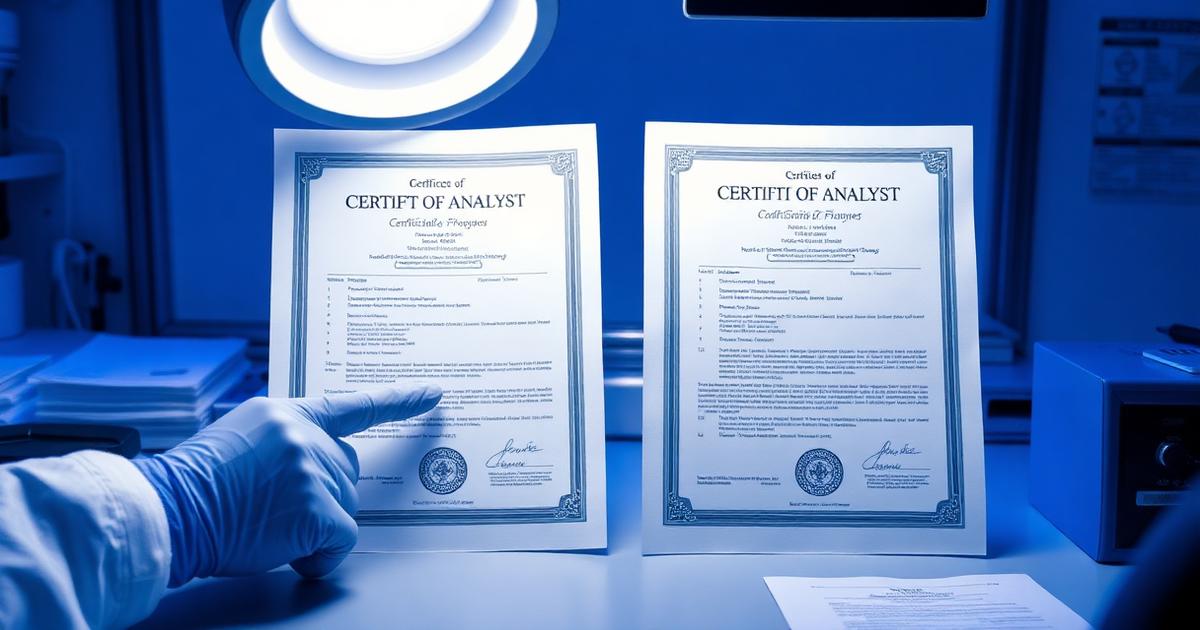
Manufacturer COA vs Third-Party COA: What Actually Differs

A side-by-side breakdown of manufacturer Certificates of Analysis vs independent third-party COAs — what data is included, what is omitted, and why it matters for compounding pharmacies and research labs.

July 7, 2026
Last reviewed

# Manufacturer COA vs Third-Party COA: What Actually Differs

Every peptide vial ships with a Certificate of Analysis (COA). Most buyers assume a COA is a COA. It is not. A manufacturer-issued COA and an independent third-party COA are built for different audiences and disclose very different things.

What a manufacturer COA typically shows

A manufacturer COA is a release document. Its job is to certify that a specific lot passed the supplier's internal quality gate before it left the facility. Common fields:

  • Peptide name and lot number
  • Reported purity percentage (usually HPLC area %)
  • Molecular weight (sometimes theoretical, sometimes measured)
  • Appearance, solubility, and net peptide content
  • A single chromatogram thumbnail (often unlabelled)

What manufacturer COAs frequently omit: the analytical method version, the column and mobile phase used, integration parameters, related substances (impurity peaks named and quantified individually), heavy metals data, residual solvents, endotoxin values in EU/mg, water content by Karl Fischer, and the identity of the analyst or lab that ran the test.

What a third-party COA is supposed to add

An independent lab has no commercial interest in the lot passing. Its COA is an audit document. A useful third-party COA includes:

  • Full method disclosure (column, gradient, wavelength, injection volume, temperature)
  • Named impurity peaks with retention times and area %
  • Orthogonal identity confirmation (LC-MS with observed vs theoretical mass, delta ppm)
  • Heavy metals by ICP-MS with individual element limits
  • Residual solvents by GC-MS against ICH Q3C class limits
  • Endotoxins by LAL (kinetic chromogenic) in EU/mg
  • Water content by Karl Fischer titration
  • Analyst signature, accreditation reference, and report date

The chromatogram is full-page, annotated, and reproducible.

Need Your Peptides Tested?

ACS Peptide Testing Labs provides fast, accurate HPLC purity testing, mass spectrometry identity confirmation, and comprehensive Certificate of Analysis.

The five differences that matter most

  1. Purity accounting. Manufacturer COAs often report a single purity number without disclosing how minor peaks were handled. Third-party COAs itemize related substances so a 99.1% peptide is not hiding a 0.7% deamidation impurity.
  2. Identity. "MW confirmed" is not the same as an LC-MS deconvoluted mass matched to theoretical within a few ppm.
  3. Method transparency. If the method is not disclosed, the result is not reproducible.
  4. Contaminant scope. Heavy metals, residual solvents, and endotoxins are almost never on manufacturer COAs for research peptides.
  5. Accountability. Third-party COAs put a lab and an analyst behind the numbers.

When each is appropriate

Manufacturer COAs are fine for early screening and lot traceability. They are not sufficient for 503A/503B compounding pharmacy release, for research where publication data will be scrutinized, or for supplier audits where you need evidence that survives a regulator's review. In those cases, an independent COA is the artifact you want in the file.

What to ask for

When requesting third-party testing, ask specifically for: HPLC purity with related substances table, LC-MS mass confirmation, ICP-MS for the four USP elemental impurities plus As, and LAL endotoxin if the material is going toward an injectable use. That set covers most compliance and supplier-verification workflows.

A manufacturer COA tells you the lot passed. A third-party COA tells you what actually is in the vial.

Frequently Asked Questions

Ready to Verify Your Peptide Quality?

Get professional testing from a US-based laboratory. HPLC purity, mass spectrometry identity, contaminant screening with fast turnaround and comprehensive documentation.