Introduction
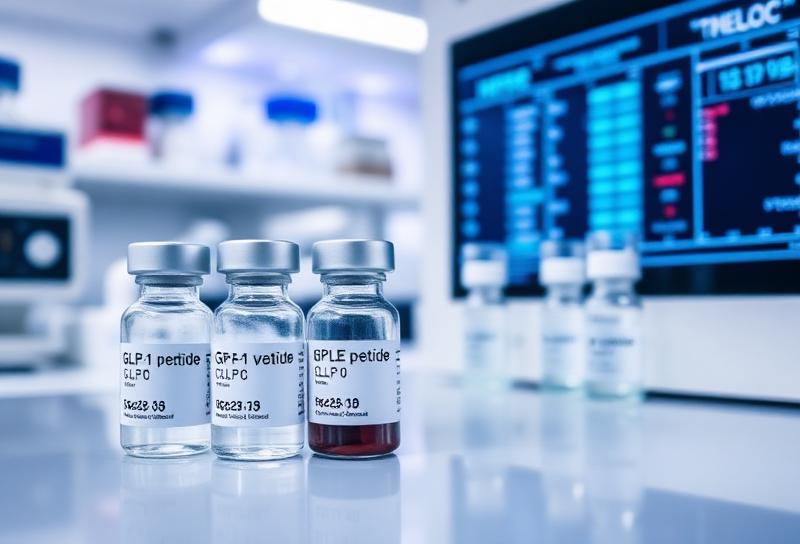
Your peptide vial says "10 mg." But how much of that is actually active peptide?
The answer might surprise you. Due to counter-ions, moisture, and residual solvents, the net peptide content of a labeled 10 mg vial is typically only 60-80% of the stated weight. That means your "10 mg" vial might contain only 6-8 mg of actual peptide.
Peptide quantity testing (also called net content testing or net peptide content analysis) determines the true amount of active peptide in your sample. This is one of the fastest-growing testing requests at ACS Peptide Testing Labs.
What Is Net Peptide Content?
Net peptide content is the actual mass of biologically active peptide in a sample, corrected for:
Counter-Ions (TFA Salts)
Most synthetic peptides are purified using trifluoroacetic acid (TFA) as part of the HPLC purification process. TFA binds to basic amino acid residues (Lys, Arg, His) as counter-ions. For a typical peptide:
- TFA salt content: 10-30% of total weight
- A peptide with 3 basic residues might have 15-20% of its weight as TFA
Moisture Content
Lyophilized peptides can absorb atmospheric moisture:
- Typical moisture: 2-8% of total weight
- Hygroscopic peptides can absorb even more
- Proper desiccant storage minimizes this
Residual Solvents
Trace amounts of solvents from synthesis and purification:
- Acetonitrile, DMF, DMSO
- Usually 1-3% of total weight
- Tested via headspace gas chromatography
Why Net Content Testing Matters
Accurate Dosing
If your research protocol calls for 500 μg of peptide and your vial contains 70% net peptide content:
- Without correction: You weigh 500 μg → actually deliver 350 μg
- With correction: You weigh 714 μg → actually deliver 500 μg
This 30% dosing error can dramatically affect research results, especially for dose-response studies.
Supplier Verification
Net content testing reveals whether you're getting what you paid for:
- A "15 mg" vial of Retatrutide at 65% net content = 9.75 mg actual peptide
- At $50/mg, that's a $262.50 difference between labeled and actual content
- Suppliers should disclose net peptide content, but many don't
Regulatory Requirements
For peptides in preclinical or clinical development:
- ICH guidelines require net peptide content determination
- GMP specifications mandate content uniformity testing
- FDA submissions need accurate concentration data
How We Test Net Peptide Content
Amino Acid Analysis (AAA)
The gold standard for net peptide content determination:
- Hydrolyze the peptide into individual amino acids using acid hydrolysis (6N HCl, 110°C, 22 hours)
- Derivatize amino acids for detection
- Quantify each amino acid against known standards
- Calculate total peptide content from amino acid ratios
Advantages: Most accurate method; works for all peptides
Turnaround: 9-11 business days
UV Spectrophotometry
A faster, complementary method:
- Dissolve the peptide at a known concentration
- Measure UV absorbance at 280 nm (for peptides containing Trp, Tyr)
- Calculate concentration using the extinction coefficient
Advantages: Fast and simple
Limitations: Requires aromatic amino acids; less accurate than AAA
Karl Fischer Moisture Analysis
Determines water content specifically:
- Sample a portion of the lyophilized peptide
- Titrate with Karl Fischer reagent
- Report moisture as percentage of total weight