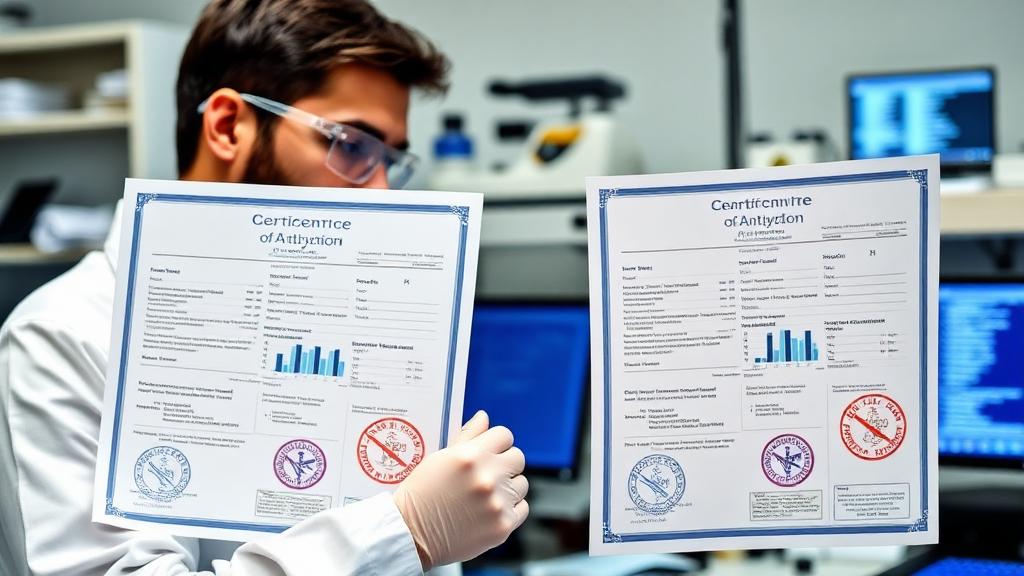
How to Verify Your Peptide Supplier with Independent Lab Testing
Choosing the wrong peptide supplier can derail months of research, expose patients to substandard ingredients, or destroy your business reputation. Yet most buyers rely solely on the supplier's own documentation -- a Certificate of Analysis (COA) produced by the same company selling the product.
Independent testing checks the material received against supplier documentation. This guide outlines a verification workflow for research and pharmacy procurement.
Why Supplier Verification Matters
Who's at Risk?
- Researchers -- Impure peptides produce unreliable experimental results, wasting time and funding
- Compounding pharmacies -- Substandard APIs put patients at risk and invite FDA enforcement
- Distributors and resellers -- Your reputation depends on the quality of what you sell
- Supplement companies -- Inaccurate ingredients create liability exposure
- Procurement teams -- Compare lot-specific material with documentation
The 5-Step Supplier Verification Framework
Step 1: Request and Evaluate the Supplier's COA
Before placing an order, request a sample COA for a recent batch. A credible COA should include:
Must-have elements:
- Actual HPLC chromatogram (not just a purity number)
- Mass spectrum showing molecular weight confirmation
- Specific batch/lot number and date of analysis
- Analyst name or signature
- Method details (column type, mobile phase, detection wavelength)
- Clear acceptance criteria and pass/fail results
Red flags that suggest an unreliable COA:
- Perfectly round purity numbers (e.g., exactly 99.0% or 98.0%)
- No chromatogram or spectrum attached
- Generic template format with no specific method details
- Same COA reused across multiple batch numbers
- Purity claims consistently above 99.5% (extremely rare in practice)
For a detailed walkthrough, see our guide on how to verify a peptide COA.
Step 2: Order a Test Sample and Send for Independent Analysis
This is the most important step. Order a small quantity from the supplier and submit it directly to an independent testing laboratory like ACS Peptide Testing Labs.
What to test:
| Test | What It Tells You | Cost |
|---|---|---|
| HPLC Purity | Actual purity vs. supplier's claim | $150--250 |
| Mass Spectrometry | Whether the peptide is the correct compound | $200--350 |
| Combined (Purity + Identity) | Complete verification in one analysis | $300--500 |
- Does the independent purity match the supplier's COA within +/-2%?
- Does the molecular weight confirm the correct peptide identity?
- Are there unexpected impurity peaks not shown on the supplier's chromatogram?
Step 3: Evaluate Multiple Lots (Not Just One)
A single good test result doesn't guarantee consistent quality. Supplier quality can vary dramatically between batches due to:
- Different synthesis runs or raw material lots
- Changes in manufacturing processes
- Varying storage and shipping conditions
- Different contract manufacturers being used
Best practice: Test at least 3 separate lots from a new supplier before qualifying them as a regular source. Then implement periodic re-testing as part of your ongoing quality program.
Step 4: Cross-Reference Supplier Claims
Beyond lab testing, verify the supplier's background:
- Verify stated certifications -- Ask for copies of ISO, GMP, or other certificates and confirm with the issuing body
- Check regulatory history -- Search FDA warning letter databases for the supplier name
- Request references -- Ask for 2-3 other customers you can contact
- Audit manufacturing location -- If feasible, visit or request a virtual tour of their facility
- Verify API sourcing -- Where does the supplier obtain their raw peptide? Is there documentation back to the synthesizer?
Step 5: Establish Ongoing Monitoring
Supplier verification isn't a one-time event. Establish a routine testing schedule:
| Business Type | Recommended Testing Frequency |
|---|---|
| Research laboratory | Test first lot from any new supplier; spot-check 20% of ongoing lots |
| Compounding pharmacy | Test every incoming lot (identity + purity minimum) |
| Distributor/reseller | Test first 3 lots, then monthly random sampling |
| Consumer/individual | Test any high-value or safety-critical purchase |
Real-World Verification Case Studies
Case 1: GLP-1 Peptide Distributor
A peptide distributor shipping Semaglutide to compounding pharmacies submitted 12 lots for independent verification over 3 months.
Results:
- 9 of 12 lots (75%) showed purity below the supplier's COA claims
- Average purity gap: 9.3 percentage points
- 2 lots contained detectable heavy metal contamination
- The distributor switched suppliers based on this data
Case 2: Research Lab Peptide Audit
A university research laboratory running BPC-157 healing studies tested peptides from 4 different suppliers.
Results:
- Supplier A: Consistent purity within 2% of claims (qualified)
- Supplier B: 12% average purity gap (rejected)
- Supplier C: Correct purity but wrong stereochemistry detected (rejected)
- Supplier D: Good purity but endotoxin contamination detected (rejected)
- Only 1 of 4 suppliers passed full verification
Case 3: Compounding Pharmacy Compliance
A 503B outsourcing facility implemented mandatory incoming testing for all Tirzepatide lots after an FDA inspection flagged inadequate supplier qualification.
Results:
- Identified 2 lots with purity below acceptance criteria before they entered production
- Passed subsequent FDA re-inspection with complete testing documentation
- Estimated cost savings from avoiding an FDA warning letter: $100,000+