Skip to main contentSkip to main content
Back to Blog
Testing Methods

HPLC vs Mass Spectrometry: Choosing the Right Analytical Method

Compare different analytical approaches for peptide verification and learn when to use each technique.

Updated

Introduction

HPLC and mass spectrometry are complementary techniques for peptide analysis. Understanding their strengths and limitations helps researchers select the right approach for their specific needs.

HPLC: Strengths and Applications

What HPLC Does Best

Quantitative Purity Analysis

  • Precise measurement of main component

  • Detection of all UV-absorbing impurities

  • Well-established quantitation methods

Separation of Related Substances

  • Resolves isomers and closely related compounds

  • Baseline separation enables accurate quantitation

  • Preparative purification possible

Routine Quality Control

  • Reproducible results

  • Cost-effective operation

  • Regulatory acceptance

Limitations of HPLC

  • Cannot provide molecular weight information
  • Similar compounds may co-elute
  • Limited structural information
  • Requires UV-absorbing compounds (or alternative detection)

When to Choose HPLC

  • Routine purity testing
  • Batch release testing
  • Stability studies (with validated methods)
  • When quantitative purity is primary concern

Mass Spectrometry: Strengths and Applications

What MS Does Best

Identity Confirmation

  • Exact molecular weight determination

  • Unambiguous identification

  • Detection of modifications

Structural Information

  • Sequence confirmation (MS/MS)

  • Modification site localization

  • Disulfide bond mapping

Impurity Identification

  • Characterize unknown impurities

  • Determine degradation pathways

  • Support root cause investigations

Limitations of Mass Spectrometry

  • Less quantitative than HPLC (generally)
  • More complex operation
  • Higher instrument costs
  • Response varies with compound structure

When to Choose MS

  • Initial identity confirmation
  • Investigating unknown impurities
  • Sequence verification
  • Characterization of modifications

Comparing the Techniques

FeatureHPLCMS
Primary useQuantitationIdentification
CostLowerHigher
ComplexityModerateHigher
InformationPurity %Molecular weight, structure
ThroughputHighModerate
Regulatory acceptanceExcellentExcellent

LC-MS: The Best of Both Worlds

Combined Capabilities

LC-MS couples HPLC separation with MS detection:

  • Separation of complex mixtures

  • Real-time mass confirmation

  • Impurity identification during purity analysis

LC-MS Applications

Routine Analysis:

  • Purity with identity confirmation

  • Rapid method development

  • Batch comparison

Advanced Characterization:

  • Comprehensive impurity profiling

  • Stability-indicating analysis

  • Process development support

LC-MS Considerations

Advantages:

  • Maximum information per analysis

  • Efficient use of sample

  • Supports multiple objectives

Challenges:

  • Higher instrument cost

  • More complex method development

  • Mobile phase compatibility requirements

Practical Decision Framework

Step 1: Define Your Question

  • "How pure is my peptide?" → HPLC
  • "Is this the right peptide?" → MS
  • "What is this impurity?" → LC-MS
  • "Both purity and identity?" → LC-MS

Step 2: Consider Resources

Budget:

  • HPLC: Lower instrument and operational costs

  • MS: Higher investment but more versatile

Expertise:

  • HPLC: Widely accessible skillset

  • MS: Requires specialized training

Step 3: Regulatory Requirements

QC Release:

  • Often HPLC for purity

  • MS for identity (or specific HPLC conditions)

Characterization:

  • MS essential for full characterization

  • Supports regulatory submissions

Need Your Peptides Tested?

ACS Peptide Testing Labs provides fast, accurate HPLC purity testing, mass spectrometry identity confirmation, and comprehensive Certificate of Analysis.

Method Selection Examples

Example 1: Research Peptide QC

Objective: Verify purchased peptide meets specifications

Recommended approach:

  1. HPLC purity analysis

  2. MS molecular weight confirmation

  3. Optional: Amino acid analysis

Example 2: Clinical Development

Objective: Complete characterization for IND

Recommended approach:

  1. LC-MS impurity profiling

  2. Validated HPLC for purity

  3. MS/MS sequence confirmation

  4. Additional specialized methods as needed

Example 3: Stability Investigation

Objective: Understand degradation pathway

Recommended approach:

  1. LC-MS to identify degradation products

  2. Develop stability-indicating HPLC method

  3. Use HPLC for routine monitoring

HPLC vs Mass Spectrometry at a Glance

QuestionHPLC answers itMass spectrometry answers it
How pure is this peptide?Yes, as area percent of the main peakOnly indirectly
Is this the right molecule?No, retention time alone is weak evidenceYes, by intact molecular weight
What are the impurities?Shows how many and how muchIdentifies what they are
Is the sequence correct?NoYes, with MS/MS fragmentation
Is a modification present?Sometimes, by peak shiftYes, by mass difference
Cost per sampleLowerHigher
Best routine useBatch release and stability monitoringIdentity confirmation and characterization
The practical rule: HPLC quantifies, mass spectrometry identifies. A COA with only one of the two leaves a real gap, which is why our standard package runs HPLC purity testing alongside mass spectrometry identity confirmation.

What "HPLC Tested" on a Label Actually Means

"HPLC tested" is not a specification. It tells you a chromatographic run happened somewhere, not what the acceptance criteria were, who ran it, or whether the peak was pure. Before you trust the phrase, look for:

  • A purity number with the method stated (column, gradient, detection wavelength)
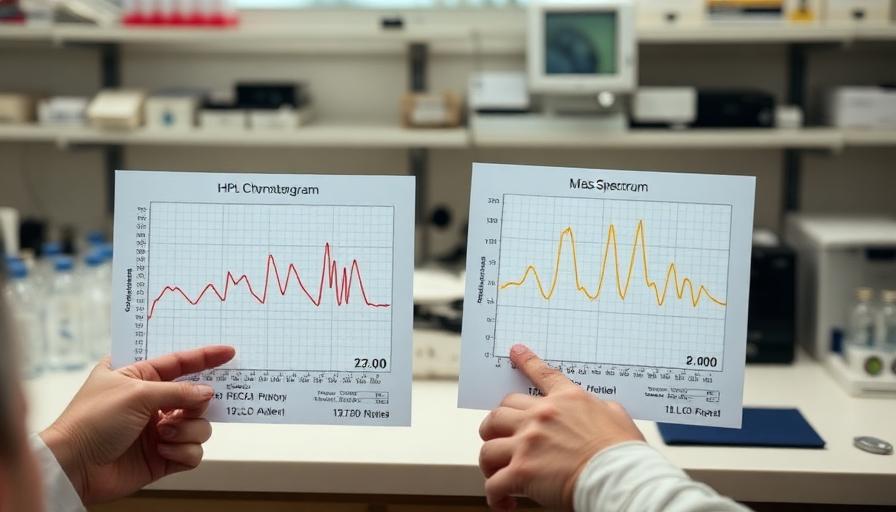
  • The chromatogram itself, not a typed summary
  • Peak purity assessment, so a co-eluting impurity is not being counted as product
  • The lab name and whether it is independent of the seller

Our walkthrough on how to read a peptide Certificate of Analysis shows what a defensible report looks like line by line.

Peak Purity: Where HPLC Alone Misleads

Two compounds with similar hydrophobicity can elute at nearly the same retention time. Ultraviolet detection sees one peak and reports high purity. Coupling the same separation to a mass detector splits that peak into its actual components, which is how deletion sequences and incomplete lipidation get caught in GLP-1 analogs. This is a recurring finding in our data on common peptide purity discrepancies.

Reference Standards Behind Both Methods

Conclusion

HPLC and mass spectrometry serve different but complementary purposes in peptide analysis. Most comprehensive quality programs use both techniques, often combined as LC-MS for maximum efficiency.

Frequently Asked Questions

For peptide impurity profiling, researchers shipping samples from California should opt for LC-MS when precise identification and quantification of unknown impurities are critical. While HPLC is excellent for purity and separation, LC-MS provides the definitive structural information needed to characterize even closely eluting compounds, ensuring comprehensive data. Our lab, located in Sun City Center, Florida, handles these advanced analyses.

Our standard turnaround time for peptide analysis using HPLC or LC-MS is 9-11 business days from sample receipt.

For clients shipping peptide samples from New York, maintaining sample integrity is paramount for accurate HPLC and LC-MS results. We advise cold-pack overnight shipping to our Sun City Center, Florida lab to prevent degradation during transit. Upon arrival, samples are immediately processed and stored under controlled conditions to preserve their chemical profile until analysis.

For a comprehensive HPLC and LC-MS peptide purity and identity analysis, we generally require a minimum of 2-5 mg of lyophilized peptide. This quantity allows for replicate analyses and method optimization, ensuring robust and reliable data. If you have limited material, please call us at (561) 513-8435 to discuss your specific needs before sending samples.

On its own, very little. It confirms a chromatographic run happened but says nothing about the acceptance criteria, the column and gradient used, whether peak purity was assessed, or whether the lab was independent of the seller. A meaningful claim includes the purity percentage, the method conditions, the chromatogram itself, and the name of the testing laboratory.

No. HPLC separates and quantifies, so it reports how much of the main peak is present, but retention time alone is weak evidence of identity. Confirming the molecule requires mass spectrometry to measure the intact molecular weight, and MS/MS fragmentation when sequence confirmation is needed. This is why our standard package pairs HPLC purity with LC-MS identity.

Ready to Verify Your Peptide Quality?

Get professional testing from a US-based laboratory. HPLC purity, mass spectrometry identity, contaminant screening with fast turnaround and comprehensive documentation.